
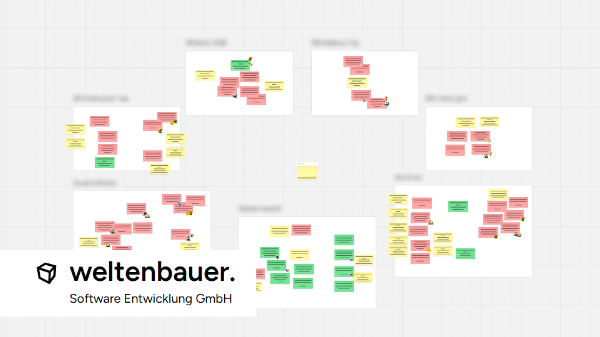
| Role | Workshop Facilitator, Product Design Consultant |
| Client | weltenbauer. Software Entwicklung GmbH |
| Industry | Industrial Visualization, Real-Time 3D |
| Focus | 3D Asset Management, Version Control & Review Workflows |
| Skills | Decision-Making Support, Workshop Facilitation, User Research, Persona Development, Requirements Engineering |
| Tools | Miro, Microsoft Teams |
Case Context
A mid-sized software company aimed to improve how 3D assets are managed, versioned, and reviewed within real-time and industrial visualization workflows.
Existing processes were disconnected, especially at the intersection of CAD data, DCC applications and real-time engines, leading to inefficiencies and limited transparency across teams.
Table of Content
Motivation
The goal was to establish a shared understanding of current challenges, identify key requirements, and create a foundation for selecting suitable tools and workflows. Particular focus was placed on bridging gaps between technical constraints and user needs in complex 3D pipelines, including CAD-to-mesh transformations.
My Role
I designed and facilitated a structured remote workshop, guiding participants through collaborative exercises to uncover user needs, define initial personas, and translate findings into prioritized requirements. In addition, I synthesized the outcomes, conducted further research, and translated the findings into actionable insights to support decision-making around potential solutions.
Research
In preparation for the workshop, I conducted several exploratory conversations with a key stakeholder from the client team to understand existing workflows, challenges, and goals. These discussions provided insights into current practices around 3D asset management, version control, and review processes, forming the basis for a workshop tailored to the client’s needs and ensuring that relevant topics and challenges were addressed effectively.
Workshop
I designed and facilitated a structured remote workshop to collaboratively explore current workflows, identify pain points and existing strengths, and derive initial personas and requirements. The session combined structured individual contributions with group discussions and synthesis phases, using a shared Miro board as the central workspace.
The workshop followed a step-by-step approach: capturing participant perspectives, clustering insights, and progressively refining them into more structured outcomes. Methods such as collaborative mapping, prioritization with the Impact/Effort Matrix, and iterative refinement were used to ensure alignment across stakeholders and to make implicit knowledge explicit.
Personas
To better capture different perspectives within the asset workflow, the foundation for lean personas was established during the workshop. Participants contributed insights into their tasks, responsibilities, and needs, which were discussed and structured collaboratively.
Five core personas were identified among the participant group, while three additional proto-personas were defined to represent relevant perspectives not covered by attendees.
Based on these inputs, preliminary personas were further developed after the workshop as part of the documentation. While not final, they were already used in part to inform the structuring and prioritization of requirements and will continue to serve as a reference for future alignment and decision-making.
Requirements
Based on the insights gathered, initial requirements were identified, structured, and prioritized. The focus was on translating observed needs and challenges into a clear and actionable set of requirements without prematurely narrowing potential solutions.
This step was essential to create a shared understanding of what a future system needs to support, and to establish a solid foundation for evaluating tools, defining workflows, and guiding further decision-making.
Handout
Following the workshop, I consolidated and expanded the results into a structured handout. This included the documentation of key insights, an initial set of structured and prioritized requirements, and the further development of preliminary personas.
In addition, the handout provides an initial overview and comparison of relevant software solutions and an assessment of their suitability, based on the identified requirements and project context.
The handout serves as a shared reference for stakeholders, supporting alignment, enabling informed decision-making, and providing a foundation for further exploration and follow-up activities.
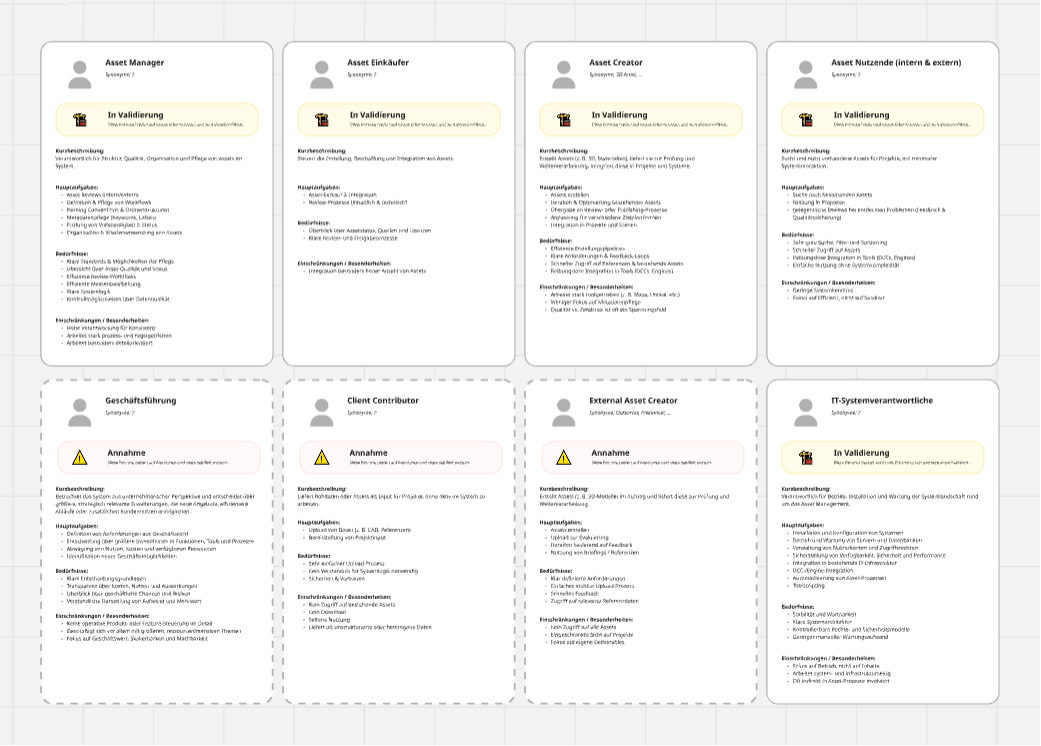
Work-in-progress view of initial persona development during the workshop. Details intentionally limited due to confidentiality.
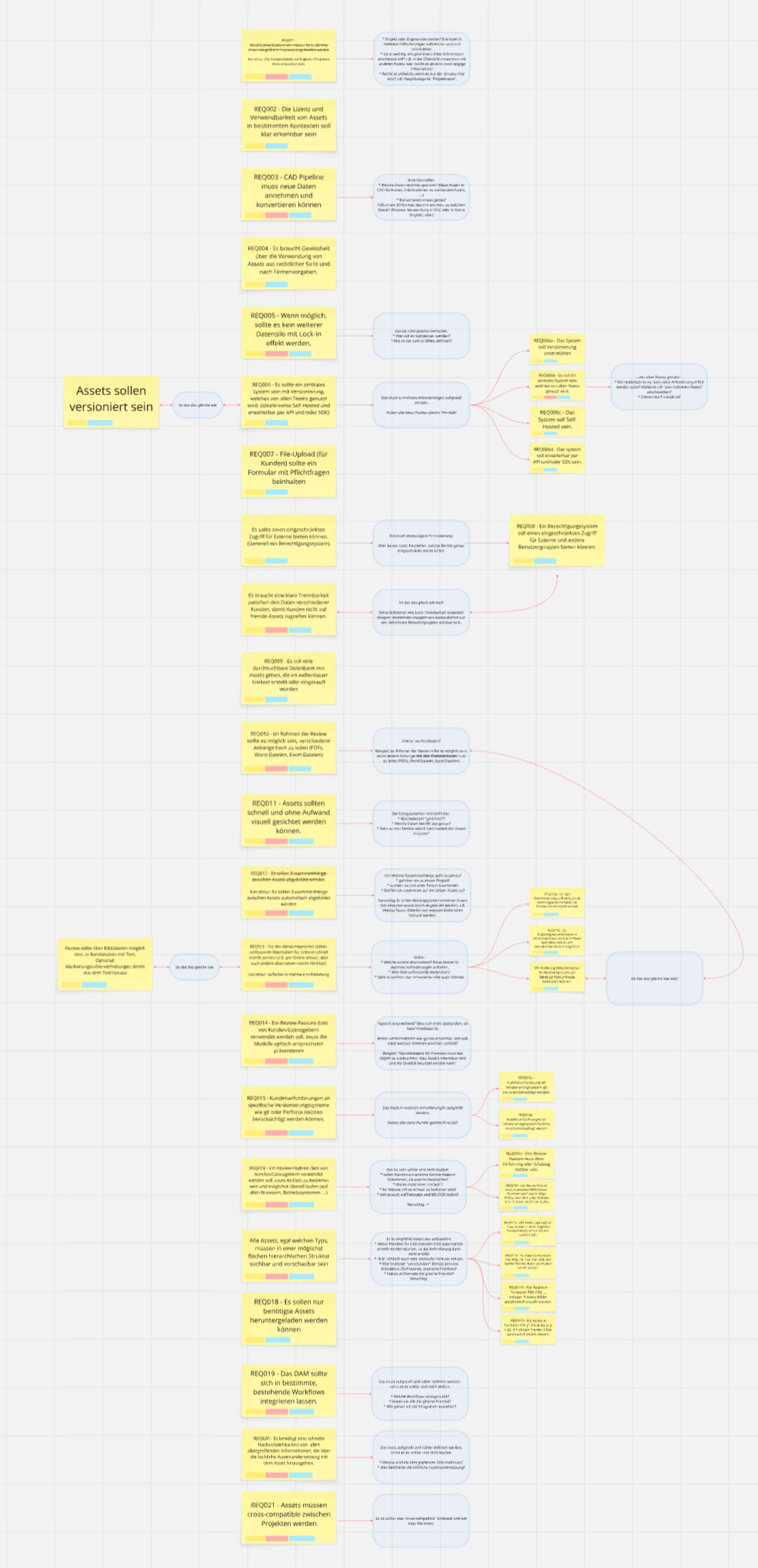
Work-in-progress view of requirement definition during the workshop. Details intentionally limited due to confidentiality.
Outcome
The workshop established a shared understanding of current challenges and aligned stakeholders across disciplines. Key user needs were identified and translated into an initial set of structured and prioritized requirements, forming a clear foundation for further decision-making.
In addition, first lean personas were developed to represent core user perspectives within the 3D asset workflow. These were complemented by documented insights into existing processes, pain points, and gaps particularly across CAD, 3D applications, and real-time environments.
The results were consolidated, refined, and expanded through follow-up analysis and research, leading to a set of actionable recommendations and a structured basis for evaluating suitable tools and system architectures.